
Convector Heat Output Calculation: How to Get It Right
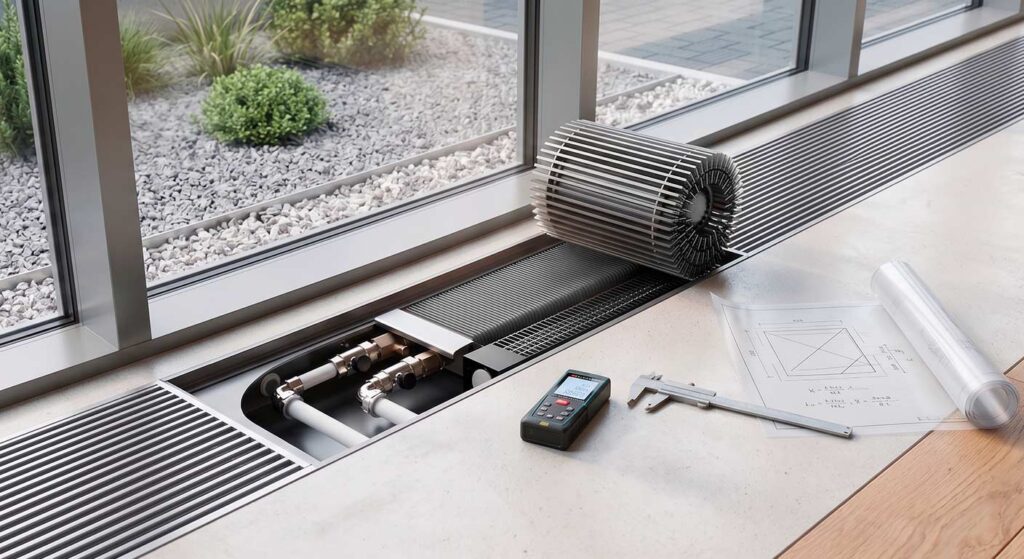
Getting the convector output wrong is expensive: an undersized unit won’t heat the room in a cold snap, while an oversized one means overpaying for equipment and installation. Let’s look at how to size it correctly — and why a rough “by floor area” guess often fails.
A quick estimate by area
Rough guide: about 100 W per m² with standard ceiling height and normal insulation. For rooms with panoramic glazing, budget more — 150–200 W/m², because large panes lose noticeably more heat. This is only a first estimate: real demand depends on insulation, window orientation, region and ceiling height.
The accurate way — by heat loss
The right figure is the room’s heat loss: how much heat escapes through walls, windows, floor and roof at the design outdoor temperature. The convector must cover it. Heat loss depends on the glazing area and type, wall thickness and material, orientation and climate zone. For demanding projects it’s calculated per design; for typical cases a calculator with the key parameters is enough.
The key trap — water temperature
This is what people most often miss. A convector’s rated output is given for the EN 442 standard: 75/65 °C flow/return at a 20 °C room (the ΔT 50 regime). If your system runs cooler, the output drops — significantly.
The relationship is non-linear: Q = Q₅₀ × (ΔT / 50)ⁿ, where the exponent n for convectors is ≈ 1.3–1.5 and ΔT is the difference between the mean water temperature and the room air. In practice: at 55/45 °C (ΔT ≈ 30) a convector delivers only about half its rated output. So “datasheet watts” and real watts aren’t the same if you run a low-temperature system (heat pump, condensing boiler).
How to calculate in a minute
So you don’t have to work the formulas by hand, we built the Heatmann power calculator. It uses the manufacturer’s official datasheet tables (per EN 442): pick a model and size (height × width × length), set the flow, return and room temperatures — and instantly see the output in watts and kcal/h for your regime. For fan models you can set the speed. It’s the fastest way to get a correct figure for your exact conditions.
Do you need a safety margin?
A small margin (10–15%) is useful — it covers unusually cold spells and speeds up warm-up. But don’t oversize: an overly powerful unit cycles more, costs more and needs a bigger recess. The sweet spot is covering heat loss with a small reserve.
In short
- By area — only a rough estimate (100 W/m², panoramic 150–200).
- The right way — by the room’s heat loss.
- Always account for water temperature: at low ΔT the output is well below the rated figure.
- Fastest of all — via the calculator.
FAQ
How many watts of convector per square metre?
Roughly 100 W/m² with normal insulation and 150–200 W/m² near panoramic glazing. That’s a first estimate; the exact output is calculated from heat loss and the temperature regime.
Why is the output lower at low water temperature?
Output depends on the temperature difference between water and air (ΔT). The lower the flow temperature, the smaller the ΔT and the less the unit delivers — per Q = Q₅₀ × (ΔT/50)ⁿ. At 55/45 °C that’s about half the rated value.
What safety margin should I allow?
Usually 10–15%. A larger margin isn’t needed and leads to overpaying.
Calculate the output for your model and size in the Heatmann calculator, or see how to choose a convector. Need help — leave a request.