
Fan-Assisted Trench Convector: When You Need One
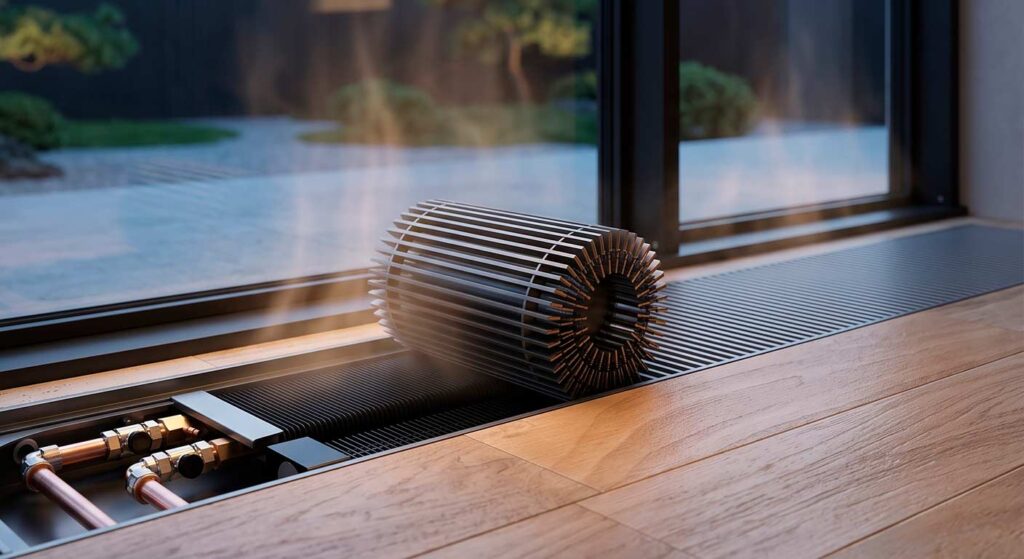
Trench convectors come in two types: natural convection and fan-assisted (forced convection). The latter deliver far more heat from the same size — but you don’t always need them. Let’s look at when a fan is worth it, and when it’s overspending.
How it works
In a natural-convection convector, warm air rises on its own. A fan model has a quiet tangential (cross-flow) fan at the bottom that pushes air through the heat exchanger. Airflow jumps sharply — and output from the same casing rises several times over (up to ~3–4× at top settings). In plain terms: the same recess delivers a lot more heat.
When you need a fan
- Floor-to-ceiling glazing, glass facades — high heat loss, where natural convection often isn’t enough.
- High ceilings (double-height spaces, open-plan living rooms) — heat needs an active push upward.
- Limited space in the screed — when you need high output but can’t fit a wide casing: a fan gives the same output more compactly.
- Fast warm-up — a fan model brings the room up to temperature noticeably faster.
For an ordinary room with moderate windows, natural convection (Heatmann Line, Line Air) — simpler and silent — is enough.
Pros and cons
Pros: several times more output, fast warm-up, compact for high output.
Cons: needs power (safe 24 V), a light noise at maximum speed, slightly more involved installation.
Fan speed and energy use
Fan speed is adjustable (e.g. 20 / 40 / 65 / 100%). Daytime at maximum — most heat and fast warm-up; at night — a quiet mode for comfort. Modern EC motors are efficient, so consumption is low. In our power calculator, for fan models you can set the speed and instantly see the output for each mode.
Heatmann models
Line Fan is a fan convector for residential and commercial spaces. For wet areas (pools, spas) there’s a stainless-steel version, Line Fan Pool.
FAQ
How much more powerful is a fan convector than a standard one?
Depending on speed — several times more (up to ~3–4× at top settings) from the same casing size.
Is the fan noisy?
Practically silent at low speeds; a light noise only at maximum. There’s a quiet mode for night.
Does it need electricity?
Yes, safe 24 V. Plan for it at the installation stage.
Not sure whether to go natural or fan-assisted? See how to choose a convector, or calculate the output right away in the calculator. Need advice — leave a request.