
Trench Convector vs Radiator: Which to Choose
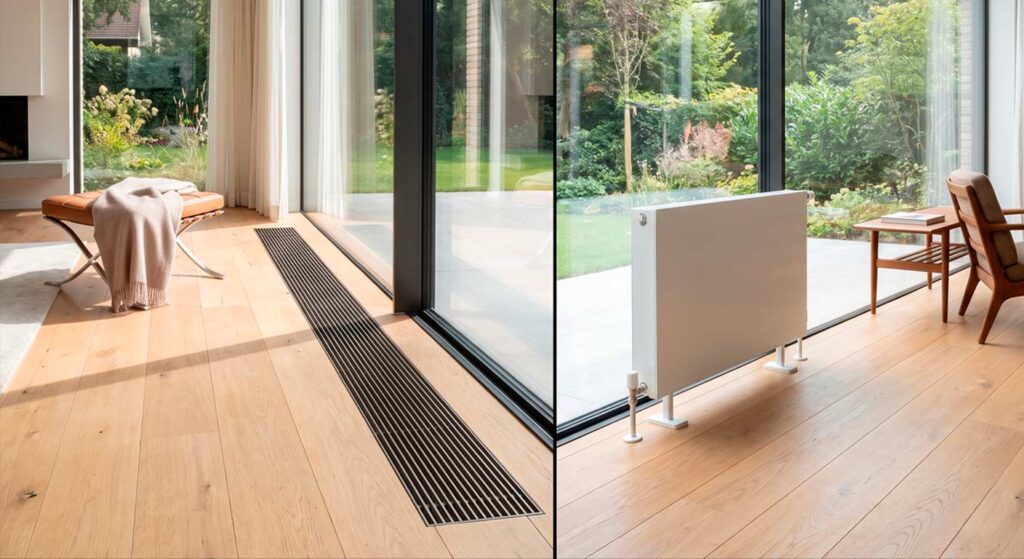
When planning heating, a common choice comes up: a familiar radiator or a trench (in-floor) convector. Both run on a water system, but they behave differently. Let’s compare honestly — no “ours always wins” — so you can pick the right one for your case.
Looks and space
A radiator hangs on the wall or stands under the window — it’s visible and takes up space. A convector is built into the floor and covered by a flush grille — barely visible. For minimalist interiors, panoramic glazing and floor-to-ceiling walls this is a decisive advantage: under full-height glazing there’s simply nowhere to put a radiator.
How they heat
A radiator emits heat by radiation and convection. A convector works by convection: it lifts a stream of warm air along the window, creating a warm curtain. That’s why a convector is especially good at glazing — it cuts off the cold from the window before it spreads across the room.
Fighting cold and condensation from windows
Here the convector wins on panoramic glazing. A warm curtain along the glass removes the draught “from under the window” and prevents condensation on the panes. A radiator under a large window helps too, but it can’t always span the full width of the glazing.
Output and dimensions
A radiator needs wall space, and its output is limited by size. A convector is run lengthwise under the window, and fan models deliver high output compactly. For high heat loss (panoramic glazing, high ceilings) a fan convector is often more convenient. Calculate and compare output for your size in the calculator.
Installation and price
Here the radiator has the edge: it’s cheaper and simpler to install, and can be fitted even in a finished room. A convector costs more and needs a recess in the screed — it’s planned at the construction or renovation stage with a rough floor. So it’s more of a solution for new builds and major renovations.
Which to choose
- Radiator — when the budget is tight, it’s a replacement in a finished room, or the windows are ordinary.
- Trench convector — when there’s panoramic glazing, a clean interior without wall units matters, or it’s a new build / major renovation.
FAQ
Which is cheaper — a convector or a radiator?
A radiator is cheaper and simpler to install. A convector costs more but offers concealed installation and better performance at glazing.
Which heats better at panoramic windows?
The convector: a warm curtain along the glass cuts off cold more effectively and fights condensation.
Can a convector be installed in a finished floor?
It’s difficult — you need a recess in the screed. In a finished room a radiator is easier; a convector is planned in advance.
Leaning towards a convector? See how to choose one and the model catalogue. Need advice — leave a request.